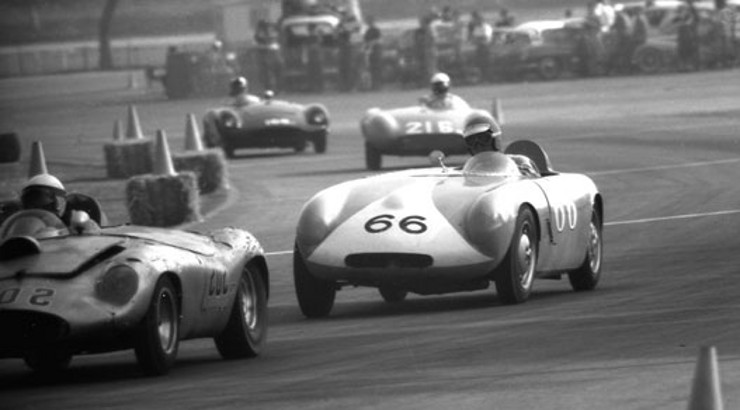
| Don Racine on the Fairchild Panhard:
"This car was found about 15 years ago
neglected and minus the original motor. When I found it, I already
owned the first of these `Nichols Specials' (Now driven for me by JP Molerus)
of France (currently running in the LA area.). We believe this
is the third of the four Nichols built. It was original raced by Perry
Peron (built at least in part by Stan Bucklin). After a little research
I was able to contact both Jerry Fairchild and Dr. Bill Molle. After
I restored the car, I was fortunate enough to be able to offer and have
Dr. Molle drive the car at Laguna Secca on its maiden run after restoration.
After Jerry passed away, Doc contacted
me and said he had a gift for me -- and that I should come visit him one
day. Several months later I paid him a visit and was stunned by the
sight: he presented me the original Twin Overhead Cam motor that Jerry
had kept for years (Jerry had passed away about 6 months earlier).
Although I still have the motor (intact) and most of the fuel injection
set-up, I have never tried to run it.
Throughout the history of the Fairchild
it was raced with various versions of Panhard power units. Among
them include the Fuel Injected units as described in the `Sportscar Specials'
book. It was also raced with a fuel injected twin overhead cam, one
of a kind Panhard engine developed by Jerry Fairchild. This car was
also run with a production supercharger as used on the Panhard Junior!
Currently the car is run with a motor
developed by Don Racine which is a copy of the motor as used in the Aardvark.
Now for SALE- $25,000 OBO!"
Article in "Sportscar Specials of the
1960's":
"Of the hundreds of Panhards built-up
for racing, Dr.Bill Molle's is a standout. Winning the H-modified
Division in California Sports Car Club's Pacific Coast Champion- ship two
years in succession (1958-1959) is quite a feat..the competition is rough,
rugged and fast. He also copped 2nd in H-modified standings in SCCA Regional
awards in 1958, and Class H-modified number two spot in Motoracing's Pacific
Coast Championship in 1959. Aside from the fact that Bill Molle is
a leadfoot, the secret of this car's winning ways lies in it's Fairchild
Panhard power-plant...the first successful fuel injected system for two
cylinder, four stroke engines. Jerry Fairchild, designer of the system,
is currently dickering with the French Panhard factory for manufacturing
rights. The chassis, with tubular space frame and stressed inner paneling,
was originally built by Perry Peron, and raced by him on West Coast events.
The fiberglass body was designed by Murry Nichols, and later redesigned
and rebuilt by Jim Byers, of El Segundo, California. Dr. Molle's reason
for owning a special is, "To get maximum racing for minimum money, and
to experiment with mechanical improvements."
Specifications:
Engine: Fairchild Panhard, 2 cylinder
4-stroke, of 747cc (45 cu.in.), fuel injected, running on a 9.5:1 compression.
It develops 67bhp at 6,500rpm. Transmission: Four speed box integral with
front wheel drive system, synchromesh 2nd thru 4th.
Chassis: Multi-tube space frame with
stressed aluminum panels. Front suspension is inde- pendent with two transverse
springs,rear is semi-independent with `V' axle and flexible center housing,
and six transverse torsion car, with adjustable Houdaille shocks all around.
Steering is rack and pinion. Front brakes have aluminum drums, steel at
the rear.
Dimensions: Wheelbase 84 ic., overall
length 112 in., overall height 32 in., overall width 48 in., minimum ground
clearance 5 in. Front tread width 48 in., rear tread 48 in. Tires
are 4.50X15 front and rear. Weight 984lbs., with a distribution of 60%
in front and 40%
at the rear. Fuel capacity six gallons.
Performance: Top speed 118mph; speed at the quarter mile 84mph."
Fred
Puhn identifies #202
"I know the car shown in front of #66,
Dr. Molle, Pomona, March 6, 1960. This was Lou Fageol in his last
race driving #202. This car formerly was the Harry Jones Devin special
#20. Lou bought it from Jones, got his friend Bill Devin to build
a lightweight body, and installed one of his Fageol 44 engines (formerly
Crosley). He put in a Porsche transaxle and modified it to have 5
speeds forward by sticking a forward gear where reverse was. The
rear suspen- sion was swing axles. To compensate for the oversteer
he used tiny 12” Michelin X tires on the front and 6” wide Midget asphalt
slicks on the rear. This had to be the first car I ever
saw running slicks on a road course.
The car had 50 hp and turned 9000 rpm. In 1960 his driver George
Peterson was highly competitive with Dr. Molle and the other top drivers
in the class.
I know this car very well because I was
in the pit crew. The body in this photo looks very rough because
George Peterson flipped it in testing the day before the race. After
an all-night session the car was patched up enough to run at Pomona.
Lou Fageol got into the car because George was too beat up to drive.
(Roll bars were very low in those days.) Lou was in his 60s at the
time but he was still very competetive. On the first lap of the race
Dr. Molle and Lou had a coming together in a fast turn and Lou ended up
bottom side up in the haybales. I remember Lou in the pits after
the accident with milk in one hand (for his ulcer) and trying to hold back
Al Bond our mechanic with the other hand (who wanted to punch Dr. Molle’s
lights out).
The engine and transmission were pulled
out after the race and I purchased the rest of the car as a project.
This was my first race car, but now that I was fully employed at Santee
automobiles I never got it on the track. Several years later I sold
it.
When it was running in a test session
I got to drive it at Hourglass Field. This was my first drive in
a real race car and I was hooked forever."
Dave Clark adds this info on #216:
"The #216 in the background looks like
it could be Ingvar Lindqvist's Saab Double- Ender. I compared it against
a photo in Vintage Motorsports
magazine, March/April 1993, page 28. The body style is the same and both
drivers are wearing white helmets with a tinted bubble shield." |